FRAEW Meaning Explained: A Complete Guide to External Wall Fire Reviews
If you work with residential buildings, manage property portfolios, own flats in a higher-risk building, or need to satisfy lender requirements, you have probably come across the term FRAEW.
At a Glance
FRAEW stands for Fire Risk Appraisal of External Walls.
A FRAEW is a risk-based assessment, not a pass-or-fail inspection.
A FRAEW and an EWS1 serve different purposes.
If you work with residential buildings, manage property portfolios, own flats in a higher-risk building, or need to satisfy lender requirements, you have probably come across the term FRAEW. Yet many building owners, leaseholders, managing agents, and developers still ask the same question: what is the meaning of an FRAEW?
Understanding FRAEW meaning has become increasingly important since the Grenfell Tower tragedy and the subsequent changes to building safety legislation, guidance, and industry practice. External wall systems have received unprecedented scrutiny, and many buildings now require specialist assessment to understand whether external wall construction presents an unacceptable fire risk.
This guide explains FRAEW meaning in plain English, explores why FRAEW assessments are carried out, how they differ from other fire safety documents, when they are required, and what building owners need to know about the process.
What is the meaning of FRAEW?
FRAEW stands for Fire Risk Appraisal of External Walls.
A FRAEW is a specialist fire safety assessment that evaluates the fire risks associated with a building’s external wall construction. The assessment considers the materials, design, configuration, and condition of the external wall system to determine whether it presents an unacceptable fire risk.
The methodology for carrying out a FRAEW is established in PAS 9980, which provides guidance for competent fire engineers and assessors undertaking these reviews.
The primary purpose of a FRAEW is to:
- Identify fire risks associated with external wall construction
- Assess the likelihood and consequences of fire spread
- Determine whether remediation is required
- Support informed risk management decisions
- Provide evidence to lenders and other stakeholders where appropriate
Understanding FRAEW meaning starts with recognising that it is a risk-based assessment rather than a simple pass-or-fail inspection.
Why Was FRAEW Introduced?
To understand FRAEW meaning fully, it is important to understand why the process was developed.
Following the Grenfell Tower fire, concerns emerged regarding combustible materials used within external wall systems on residential buildings across the UK.
Many buildings featured:
- Aluminium composite material (ACM) cladding
- High-pressure laminate (HPL) cladding
- Combustible insulation
- Timber cladding systems
- Inadequate cavity barriers
- Poor fire stopping
- Complex façade designs
Initially, lenders relied heavily on EWS1 forms to assess potential risks. However, the industry needed a more consistent and structured approach to evaluating external wall fire performance.
PAS 9980 was subsequently developed to provide a standard methodology for assessing external wall risks and determining whether remediation works were proportionate.
As a result, FRAEW assessments became the recognised mechanism for evaluating external wall fire risk.
What Is an External Wall System?
A key part of understanding FRAEW meaning involves understanding what constitutes an external wall system.
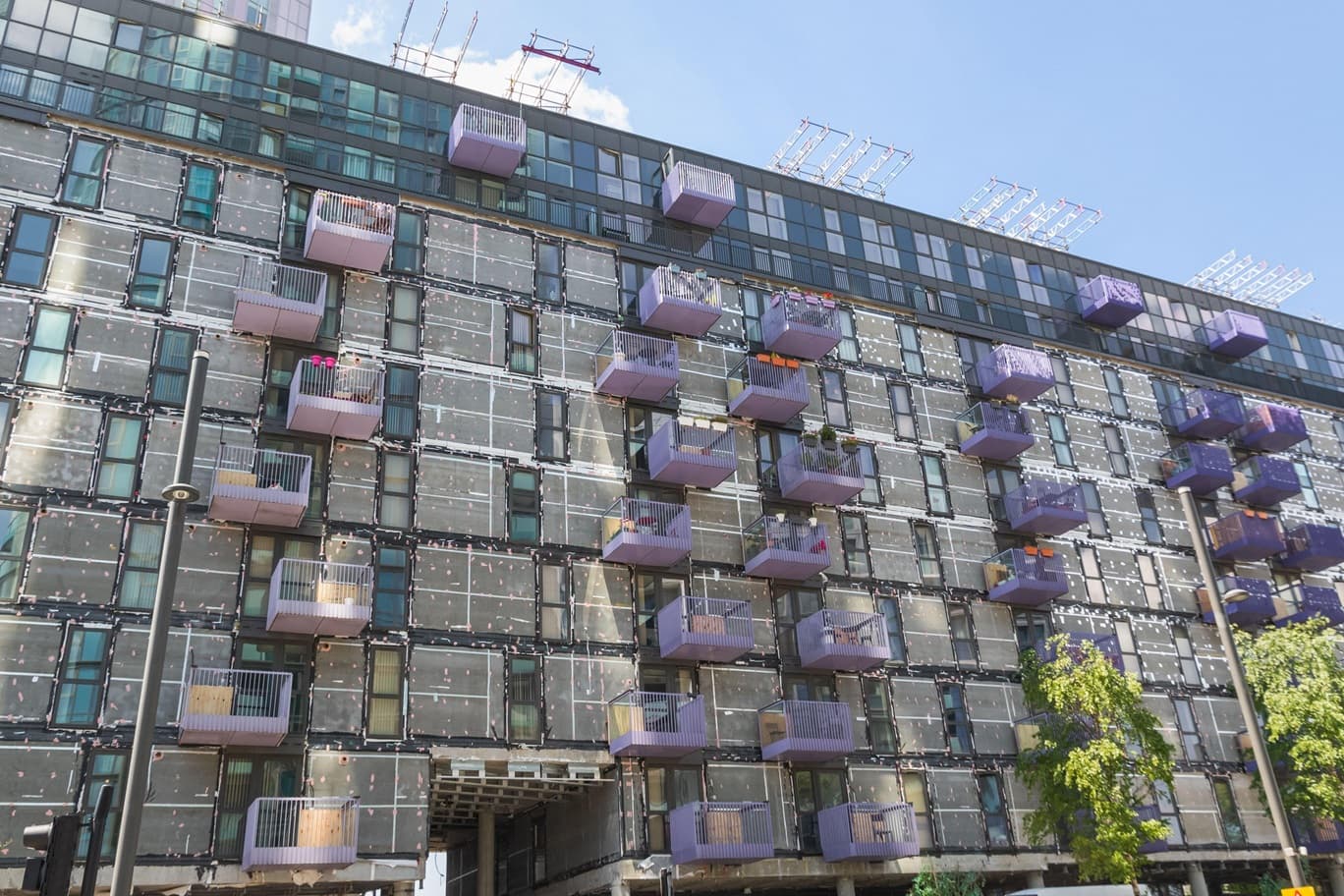
The external wall system includes far more than visible cladding panels.
It may comprise:
- External cladding
- Insulation materials
- Cavity barriers
- Fire stopping
- Support rails and fixings
- Breather membranes
- Sheathing boards
- Balconies
- External attachments
- Decorative features
- Spandrel panels
- Window interfaces
Each component can influence fire behaviour.
A FRAEW considers how all these elements interact during a fire scenario rather than reviewing individual products in isolation.
What Does a FRAEW Assessment Involve?
A FRAEW follows a structured methodology based on PAS 9980 principles.
Although every building differs, a typical assessment includes several stages.
Desktop Review
The assessor reviews available information including:
- Construction drawings
- Fire strategy documents
- Building control records
- Product specifications
- Previous surveys
- Fire risk assessments
- Remediation records
This stage helps identify likely construction details and areas requiring further investigation.
Intrusive Investigation
Most FRAEW assessments require opening-up works.
Investigations may involve:
- Removing cladding panels
- Inspecting insulation
- Examining cavity barriers
- Reviewing fire stopping
- Verifying construction details
Without intrusive inspection, the assessor may be unable to determine accurately what materials are present within the wall system.
Risk Assessment
The fire engineer evaluates:
- Probability of ignition
- Potential fire spread mechanisms
- Occupant vulnerability
- Building height
- Means of escape
- Fire service intervention
- Consequences of fire spread
This holistic approach forms a fundamental part of FRAEW meaning.
Recommendations
The assessor produces recommendations based on the identified risk level.
These may include:
- No action required
- Management measures
- Additional investigations
- Targeted remediation
- Extensive remediation works
Not every FRAEW results in remediation recommendations.
Many buildings demonstrate acceptable risk levels following detailed assessment.
Who Needs a FRAEW?
Many different stakeholders may require a FRAEW.
Building Owners
Freeholders often commission FRAEWs to understand building safety risks and meet regulatory obligations.
Managing Agents
Managing agents frequently require FRAEWs to support building management decisions and respond to lender enquiries.
Resident Management Companies
Resident-led organisations often commission FRAEWs where concerns exist regarding cladding or external wall construction.
Developers
Developers may obtain FRAEWs for existing assets, conversion projects, or buildings undergoing remediation.
Leaseholders
Leaseholders often become involved because mortgage lenders request evidence regarding external wall fire safety.
When Is a FRAEW Required?
One of the most common questions relating to FRAEW meaning concerns when assessments are required.
There is no universal legal requirement stating that every residential building must have a FRAEW.
However, circumstances that commonly trigger a FRAEW include:
- Mortgage lending requirements
- EWS1 assessments
- Suspected combustible cladding
- Building Safety Act compliance
- Fire risk assessment recommendations
- Insurance concerns
- Building sales or refinancing
- Regulatory enquiries
The need depends on the building’s characteristics and risk profile.
How Does a FRAEW Differ From a Fire Risk Assessment?
People frequently confuse FRAEWs with standard fire risk assessments.
Although both assess fire risk, they serve different purposes.
Standard Fire Risk Assessment
A fire risk assessment focuses on:
- Means of escape
- Fire detection systems
- Emergency procedures
- Fire doors
- Compartmentation
- Occupant behaviour
- Fire management arrangements
It examines the building as a whole.
FRAEW
A FRAEW focuses specifically on:
- External wall construction
- Cladding systems
- Insulation materials
- Façade fire spread
- Cavity barriers
- External fire behaviour
It provides a much deeper review of façade-related fire risks.
A FRAEW therefore complements, rather than replaces, a fire risk assessment.
How Does a FRAEW Relate to PAS 9980?
Any explanation of FRAEW meaning must include PAS 9980.
PAS 9980 is not the FRAEW itself.
Instead, PAS 9980 provides the methodology used to undertake the assessment.
The guidance sets out:
- Assessment principles
- Risk factors
- Investigation requirements
- Reporting expectations
- Competency requirements
- Risk evaluation methods
By following PAS 9980, assessors can apply a consistent approach across different building types.
What Is the Relationship Between FRAEW and EWS1?
Many people assume FRAEW and EWS1 mean the same thing.
They do not.
EWS1
The EWS1 process provides information to mortgage lenders about external wall fire risk.
It helps lenders make informed lending decisions.
FRAEW
The FRAEW provides the detailed technical assessment that often informs the EWS1 process.
In many cases:
- A FRAEW is undertaken.
- Findings are reviewed.
- An EWS1 form is completed based on available evidence.
The FRAEW provides the technical foundation, while the EWS1 serves as a lender-facing document.
What Does PAS 9980 Assess?
The PAS 9980 methodology considers numerous risk factors.
These include:
Building Height
Taller buildings generally present greater consequences if fire spreads externally.
Occupant Vulnerability
The assessment considers who occupies the building.
For example:
- Residential flats
- Student accommodation
- Sheltered housing
- Care facilities
Means of Escape
Evacuation strategies influence overall risk levels.
Combustibility of Materials
Assessors evaluate:
- Cladding
- Insulation
- Membranes
- Supporting materials
Fire Spread Potential
The review examines how rapidly fire may spread through the façade.
Cavity Barrier Performance
Missing or defective cavity barriers frequently represent a significant concern.
Balconies
Combustible balcony construction may increase risk.
Maintenance and Condition
Deterioration or poor installation can affect fire performance.
Who Can Carry Out a FRAEW?
A FRAEW should only be undertaken by suitably competent professionals.
Competence typically requires:
- Specialist fire engineering knowledge
- Experience assessing external wall systems
- Understanding of PAS 9980
- Knowledge of façade construction
- Appropriate professional qualifications
Common professional affiliations may include:
- Institution of Fire Engineers (IFE)
- Institute of Fire Safety Managers (IFSM)
- Chartered Association of Building Engineers (CABE)
- Royal Institution of Chartered Surveyors (RICS)
Building owners should always verify competency before commissioning an assessment.
What Does a FRAEW Report Contain?
A FRAEW report generally includes:
- Executive summary
- Building description
- Construction details
- Investigation findings
- Material identification
- Risk assessment methodology
- Fire risk analysis
- Conclusions
- Recommendations
The report provides a structured explanation of how conclusions were reached.
Can a Building Pass a FRAEW Without Remediation?
Yes.
One common misconception regarding FRAEW meaning is that every assessment identifies major problems.
In reality, many buildings achieve acceptable risk ratings.
The assessment may conclude:
- Risks are low
- Existing controls are adequate
- No remediation is required
- Minor management measures are sufficient
The objective is to understand actual risk rather than automatically mandate costly works.
What Happens If a FRAEW Identifies High Risk?
Where significant risks exist, recommendations may include:
- Additional investigations
- Interim safety measures
- Waking watch arrangements
- Fire alarm upgrades
- Targeted remediation
- Full cladding replacement
The extent of works depends on the identified risk and the building’s specific circumstances.
Building owners should obtain professional advice before determining an appropriate response strategy.
How Long Does a FRAEW Take?
Programme durations vary depending on building complexity.
A typical process may involve:
- Desktop review: approximately one week
- Intrusive inspections: scheduled as required
- Analysis and reporting: approximately three weeks
Complex buildings may require additional investigations and longer reporting periods.
What Does a FRAEW Cost?
Costs vary significantly depending on:
- Building size
- Height
- Complexity
- Number of elevations
- Access requirements
- Extent of opening-up works
Larger or more complex buildings generally require more extensive investigations and specialist input.
Building owners should focus on assessor competence and scope rather than selecting solely on cost.
Why Is Understanding FRAEW Meaning Important?
Understanding FRAEW meaning helps stakeholders make informed decisions about building safety, lending requirements, and remediation obligations.
For leaseholders, a FRAEW may influence mortgage availability and property transactions.
In the case of building owners and managing agents, it provides evidence-based guidance for managing external wall fire risks.
For developers and investors, it helps quantify liabilities and support strategic decision-making.
Most importantly, a FRAEW supports safer residential buildings by identifying and managing external wall fire risks appropriately.
Conclusion
Understanding FRAEW meaning is essential for anyone involved in residential property ownership, management, development, or financing. A Fire Risk Appraisal of External Walls provides a structured, risk-based assessment of a building’s façade construction and helps determine whether external wall systems present an unacceptable fire risk.
Using the methodology established in PAS 9980, competent assessors evaluate materials, construction details, fire spread potential, occupant vulnerability, and overall building risk. The resulting assessment helps building owners, managing agents, lenders, and leaseholders make informed decisions regarding safety and remediation.
If you require advice on external wall fire safety, EWS1 requirements, PAS 9980 assessments, or FRAEW surveys, Anstey Horne’s specialist fire safety consultants can provide expert guidance tailored to your building and circumstances.
FAQs – FRAEW Meaning
What is the full FRAEW meaning?
FRAEW stands for Fire Risk Appraisal of External Walls. It is a specialist assessment that evaluates the fire risks associated with a building’s external wall construction.
Is a FRAEW a legal requirement?
There is no universal legal requirement for every residential building to have a FRAEW. However, certain buildings may require one due to lender requirements, fire safety concerns, regulatory obligations, or building risk profiles.
What guidance is used for a FRAEW?
FRAEWs are typically carried out in accordance with PAS 9980, which provides the recognised methodology for assessing external wall fire risk.
Is FRAEW the same as EWS1?
No. A FRAEW is a detailed technical assessment of external wall fire risk. An EWS1 is a form used by mortgage lenders that may rely on FRAEW findings.
Who can carry out a FRAEW?
Only suitably competent professionals with expertise in fire engineering, external wall systems, and PAS 9980 assessments should undertake FRAEWs.
Does every FRAEW require intrusive inspections?
Not always, but many assessments require opening-up works to verify construction details and identify materials hidden within the external wall system.
Can a building fail a FRAEW?
A FRAEW does not operate as a simple pass-or-fail process. Instead, it identifies risk levels and provides recommendations based on the findings.
How long is a FRAEW valid?
There is no fixed validity period. However, building owners should review assessments if significant changes occur to the building, its occupancy, or relevant guidance.
Why do lenders ask for FRAEW information?
Lenders use FRAEW findings to understand external wall fire risks that could affect building safety, property value, and mortgage security.
How can Anstey Horne help?
Anstey Horne provides specialist external wall fire safety consultancy, including FRAEW assessments, PAS 9980 reviews, EWS1 support, remediation advice, and strategic fire safety guidance for residential buildings across the UK.