FRAEW Scope: Detailed Guide
What Is FRAEW Scope?
FRAEW scope defines the full extent of work required to carry out a Fire Risk Appraisal of External Walls in accordance with PAS 9980. It sets out what the assessor must review, inspect, analyse, and report to determine fire risk associated with a building’s external wall system.
You need to understand FRAEW scope if you manage, own, develop, or advise on residential buildings. A clearly defined scope ensures the appraisal is suitable and sufficient, aligns with lender expectations, and supports decisions on remediation, risk management, and certification such as EWS1.
A weak or incomplete scope leads to unreliable conclusions. In practice, that can delay transactions, increase costs, and expose duty holders to regulatory risk.
This guide explains FRAEW scope in detail. It covers what is included, how assessors structure their work, what intrusive investigations involve, and how scope varies depending on building risk.
Why FRAEW Scope Matters
FRAEW scope determines the quality and reliability of the assessment. It directly affects outcomes such as:
- Whether the building achieves a low-risk rating
- Whether lenders accept the findings
- Whether remediation is required
- Whether an EWS1 form can be issued
You should treat scope as a technical specification, not an administrative formality. A properly scoped FRAEW aligns with the intent of PAS 9980, which focuses on proportionate risk assessment rather than blanket remediation.
In many cases, early clarity on scope reduces overall project cost. You avoid repeated site visits, additional opening-up works, and conflicting conclusions from different consultants.
Core Components of FRAEW Scope
A comprehensive FRAEW scope typically includes four core stages. Each stage builds evidence that supports the final risk assessment.
1. Desktop Review
The assessor starts with a detailed desktop review. This stage gathers all available information about the building.
You should expect the following documents to be reviewed:
- As-built drawings and specifications
- Fire strategy documents
- O&M manuals
- Previous fire risk assessments
- Cladding system details
- Planning and building control records
The objective is to understand how the external wall system was designed and constructed. This informs where risks may exist and where intrusive inspection is required.
A strong desktop review reduces uncertainty before attending site. It also helps target investigations more effectively.
2. External and Internal Site Inspection
The next stage involves a physical inspection of the building. This includes both external and internal areas.
External inspection focuses on:
- Cladding type and condition
- Balconies and attachments
- Junctions and interfaces
- Signs of deterioration or modification
Internal inspection focuses on:
- Compartmentation adjacent to external walls
- Fire stopping around windows and service penetrations
- Internal linings that interact with façade systems
You should expect the assessor to take photographs, record observations, and identify areas requiring further investigation.
3. Intrusive Investigation
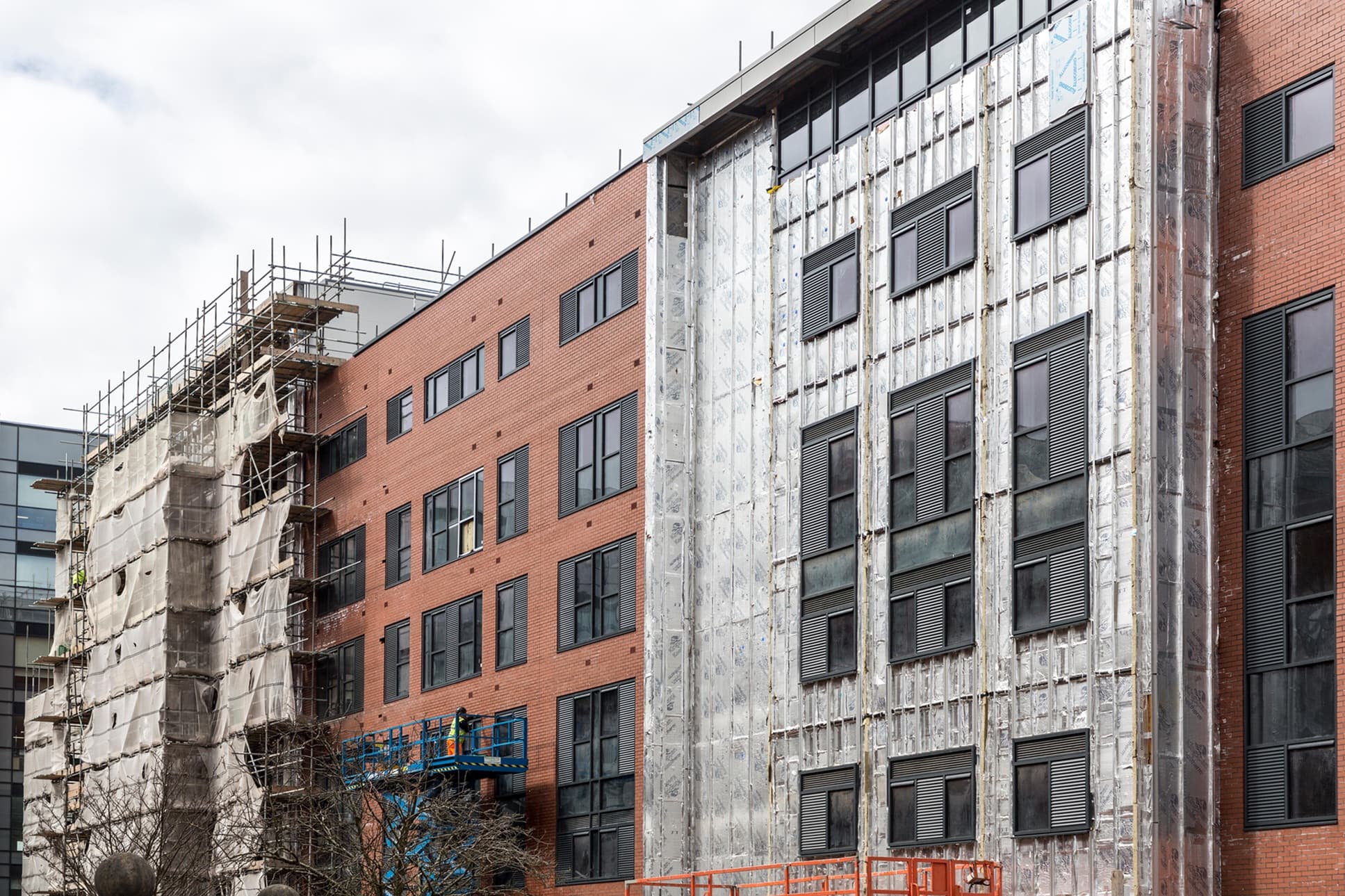
Intrusive inspection forms a critical part of FRAEW scope. Without it, the assessor cannot confirm how the wall system performs in a fire.
Typical intrusive works include:
- Opening up cladding systems
- Inspecting cavity barriers and fire stops
- Confirming insulation type and combustibility
- Checking fixing methods and workmanship
In practice, intrusive surveys often reveal issues not identified in design documentation. Industry experience shows that missing or incorrectly installed cavity barriers remain one of the most common risks.
You should plan for access requirements, making good works, and coordination with residents. Intrusive investigations usually take place over a defined period, often followed by laboratory testing if materials require verification.
4. Fire Risk Analysis and Reporting
The final stage involves analysing all gathered information and applying the PAS 9980 methodology.
The assessor evaluates:
- Likelihood of fire spread via the external wall
- Consequences for occupants and fire service
- Overall risk level
The output is a structured FRAEW report that includes:
- Building description and context
- Summary of findings
- Risk rating
- Recommendations
These recommendations may include:
- No action required
- Risk mitigation measures
- Full or partial remediation
You should treat the report as a decision-making tool. It supports funding applications, regulatory compliance, and lender engagement.
How FRAEW Scope Varies by Building Type
FRAEW scope is not fixed. It varies depending on building height, occupancy, and construction type.
Buildings Under 18 Metres
Lower-rise buildings often require a proportionate approach. The scope may include:
- Limited intrusive inspection
- Focus on specific risk elements such as balconies or insulation
- Simplified analysis
However, do not assume low-rise means low risk. Timber balconies, combustible cladding, or poor detailing can still present significant hazards.
Buildings Over 18 Metres
Higher-risk buildings require a more detailed scope. You should expect:
- Extensive intrusive investigations
- Greater scrutiny of cavity barrier provision
- Detailed fire spread modelling in some cases
Lenders and regulators typically expect a robust FRAEW for taller buildings. This forms the basis for EWS1 certification.
Complex or Mixed-Use Buildings
Mixed-use developments introduce additional complexity. FRAEW scope must consider:
- Different occupancy types
- Varied fire load profiles
- Multiple façade systems
You need a tailored approach that addresses each element of the building.
Key Technical Elements Covered in FRAEW Scope
A well-defined FRAEW scope addresses specific technical components of the external wall system.
Cladding Materials
The assessor identifies all cladding materials and evaluates their combustibility. This includes:
- Aluminium composite material (ACM)
- High-pressure laminate (HPL)
- Timber or decorative panels
Material classification plays a central role in risk assessment.
Insulation
Insulation type and installation quality significantly affect fire performance.
Scope includes:
- Identifying insulation material
- Confirming fire classification
- Assessing installation continuity
Incorrectly installed insulation can create hidden fire pathways.
Cavity Barriers
Cavity barriers limit fire spread within façade cavities. FRAEW scope must confirm:
- Presence and location
- Correct installation
- Continuity at junctions
Missing or defective cavity barriers represent a high-risk issue.
Balconies and Attachments
Balconies often fall within FRAEW scope because they can contribute to fire spread.
Assessment covers:
- Material type
- Connection to façade
- Potential for fire bridging
Timber balconies require particular attention.
Windows and Openings
Windows and façade openings influence fire spread between compartments.
Scope includes:
- Interface detailing
- Fire stopping around frames
- Potential flame spread routes
How Assessors Define FRAEW Scope
Competent assessors define FRAEW scope based on risk, not convenience. They follow a structured process.
You should expect them to:
- Review available information
- Identify knowledge gaps
- Determine required level of investigation
- Agree scope with the client
Professional competence matters. FRAEW assessors often hold memberships with organisations such as:
- RICS
- IFE
- IFSM
- CABE
- BAFE
These affiliations demonstrate experience in fire safety and building pathology.
Common Issues Identified Within FRAEW Scope
In practice, FRAEW assessments frequently identify recurring issues.
These include:
- Missing cavity barriers
- Combustible insulation
- Poor workmanship
- Incomplete fire stopping
- Unauthorised modifications
You should assume that older buildings or those with complex refurbishment histories carry higher risk.
Relationship Between FRAEW Scope and EWS1
FRAEW scope directly supports the EWS1 process.
An EWS1 form requires a competent professional to confirm the fire risk associated with the external wall. In many cases, the assessor relies on FRAEW findings to support this conclusion.
Without a robust FRAEW scope, the EWS1 process becomes unreliable. Lenders may reject incomplete or poorly evidenced assessments.
Programme and Deliverables
A typical FRAEW programme includes:
- Desktop review: around 1 week
- Intrusive survey: coordinated site phase
- Reporting: around 2 to 3 weeks
You should allow time for access arrangements, resident communication, and potential follow-up investigations.
Deliverables include:
- Full FRAEW report
- Photographic records
- Risk assessment summary
- Recommendations
How Fees Relate to FRAEW Scope
FRAEW fees reflect the complexity of the scope.
Key cost drivers include:
- Building size and height
- Number of elevations
- Extent of intrusive works
- Access requirements
- Complexity of façade systems
A larger or more complex scope increases cost, but it also improves certainty. You should focus on value rather than lowest price.
Best Practice for Clients
You can improve outcomes by managing FRAEW scope effectively.
Take these actions:
- Provide complete documentation early
- Agree scope before work starts
- Plan access for intrusive surveys
- Engage residents where required
- Appoint experienced consultants
Clear scope reduces risk, avoids delays, and supports better decision making.
FAQs on FRAEW Scope
What does FRAEW scope include?
FRAEW scope includes desktop review, site inspection, intrusive investigation, and fire risk analysis. It covers all elements of the external wall system that influence fire spread.
Is intrusive inspection always required?
In most cases, yes. Without intrusive inspection, the assessor cannot confirm critical elements such as cavity barriers or insulation type.
How long does a FRAEW assessment take?
A typical assessment takes several weeks. Desktop review may take one week, with reporting completed within three weeks after site investigations.
Does FRAEW scope differ between buildings?
Yes. Scope varies based on height, construction type, and risk profile. Higher-risk buildings require more detailed investigation.
Can FRAEW scope support EWS1 certification?
Yes. A robust FRAEW provides the technical basis for completing an EWS1 form.
Who defines FRAEW scope?
A competent assessor defines the scope based on PAS 9980 principles and the specific risks associated with the building.
Conclusion: Why FRAEW Scope Determines Outcome
FRAEW scope sits at the centre of the external wall fire risk appraisal process. It determines the depth of investigation, the reliability of findings, and the credibility of the final report.
If you define scope properly, you reduce uncertainty, avoid repeat work, and reach clear decisions faster. If you limit scope to save time or cost, you risk producing an assessment that fails to satisfy lenders, regulators, or insurers.
You should approach FRAEW scope as a technical framework that supports safe, compliant, and commercially viable buildings.
If you need guidance on defining or delivering FRAEW scope, you should engage an experienced consultancy that can manage the process end to end and provide clear, evidence-based advice.
Contact
If you’re responsible for a residential building and unsure about the safety of its external walls, speak to a competent FRAEW provider. At Anstey Horne, our expert team of fire engineers and surveyors deliver independent, proportionate, and fully compliant FRAEW Surveys.
Commission a PAS 9980-aligned FRAEW first to set your safety strategy, and let that evidence support any EWS1 a lender requests. You’ll cut duplication, reduce resident disruption, and make faster, better-defended decisions.
Get in touch with us today to arrange a no-obligation consultation - please call 020 4534 3130.
If you'd rather we called you, or for further information on FRAEW Surveys please fill in our contact form and we will be in touch.
For further information on all aspects of this service see the collection of articles in our blog.
To commission an FRAEW please call 020 4534 3130.
For further information on Fire Risk Assessment, Retrospective Fire Strategies, FRAEWs or advice in respect of your obligations as a building owner, developer or manager, please contact :

Sarah Taylor
Business Support Manager
Building Surveying
London

Thomas Mead-Herbert
BSc (Hons) MRICS C.BuildE MCABE ABBE L6 EWSA
Senior Director
Building Surveying
London

Charlie Powell
BSc (Hons) MRICS
Director
Building Surveying
Manchester